 Mohit Singh
The most honest thing the internet produced about artificial intelligence in early 2026 was not a research paper or a product launch it was a personal essay by a writer who simply stopped using ChatGPT. 30 Days Without ChatGPT let’s see what happened to their brain. Published in February 2026, the piece captured something that corporate AI evangelism never addresses: the quiet, unsettling discovery that outsourcing your thinking to a machine does not save your mind it slowly empties it. Know who has been sharing this essay across LinkedIn, X, and Substack with the caption “this is exactly what happened to me”: writers, developers, marketers, and students who recognised the same pattern in themselves the moment they read it.
The Experiment Setup
The writer behind the most-discussed version of the 30-day ChatGPT quit set one clear rule: no ChatGPT, no AI writing assistance, no using the tool as a thinking partner for any task across a full calendar month. The first few days felt fine — even productive, almost boring in their normalcy. Sources say that early feeling of competence is what makes the deeper discovery so surprising, because the real cognitive effect does not arrive immediately.
Day One: The False Confidence
The first day without ChatGPT produced no visible difficulty. Writing felt slower but manageable, research felt familiar, and the experiment seemed like it would confirm the writer was not actually dependent on the tool. Reports suggest this initial confidence is common among heavy AI users who quit — the dependency does not announce itself on the first day because the brain still holds enough recent practice to mask what has quietly eroded.
30 Days Without ChatGPT: The Wall
Around day three to five, the experiment hit its first real wall. The writer sat down to write and found not a block — but silence. The usual habit of throwing a half-formed thought into ChatGPT to let it untangle the idea simply no longer existed, and without that safety net, the brain had to do the work it had been quietly handing off. The writer described the experience directly: “I wasn’t struggling to write. I was struggling to think.”
What Actually Went Missing
Know what ChatGPT had been quietly removing from daily cognitive life without the user noticing:
- Productive friction — the mental resistance of not immediately knowing how to start something, which forces the brain to work harder and ultimately think more originally
- Idea discovery — the unexpected directions a thought takes when left to develop without AI shaping it immediately
- Ownership — the feeling of genuine authorship over an idea, which MIT research confirms declines sharply among consistent AI users
- Memory encoding — the process of retaining information that requires genuine cognitive effort to occur, which passive AI-assisted reading bypasses
- Self-surprise — the moment when your own thought goes somewhere you did not expect, which the writer described as their favourite part of thinking before ChatGPT
Week Two: Withdrawal Symptoms
By the second week, the writer described irritability, slower decision-making, and a heaviness to planning tasks that previously felt automatic. MIT research published in 2025 confirms this pattern precisely — describing consistent ChatGPT users as exhibiting “indicators of addiction” and “withdrawal symptoms” when the tool was removed, in findings that shocked even the researchers who designed the study. Know who at MIT said this was not entirely surprising given prior data: researchers who had already observed in previous studies that AI chatbot use was measurably affecting patterns of brain activity.
The MIT Brain Scan Findings
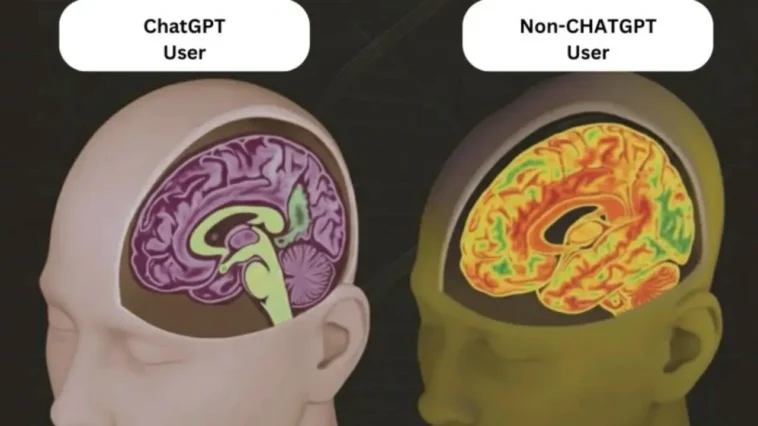
In a peer-reviewed study titled “Your Brain on ChatGPT: Accumulation of Cognitive Debt When Using an AI Assistant for Essay Writing Tasks,” MIT researchers used electroencephalogram brain scans to measure neural activity during ChatGPT-assisted writing versus unaided writing. The findings were stark: ChatGPT users showed significantly lower neural connectivity in brain regions governing memory, attention, and executive function the exact skills that define independent thinking. Participants who relied on AI also struggled to accurately recall or quote content from their own AI-assisted essays effectively failing to retain work they had technically produced.
The Creativity Collapse Research
A separate peer-reviewed study published in January 2024 and still widely cited in 2026 tracked 61 college students across a seven-day creative task experiment and then followed up 30 days later. The findings showed two specific outcomes that challenged the standard AI productivity argument:
- Participants who used ChatGPT during creative tasks saw their performance revert to baseline the moment the tool was removed — meaning ChatGPT boosted output without building actual creative capacity
- More critically, prolonged ChatGPT use produced homogenised thinking — participants began generating AI-like responses even when they were not using the tool, suggesting the model’s patterns had replaced their original cognitive signatures
- Sources say the homogenisation effect persisted even 30 days after ChatGPT use stopped — meaning the intellectual fingerprint damage outlasted the experiment itself
The Carnegie Mellon Finding
A joint study by Carnegie Mellon University and Microsoft — which has invested billions of dollars in OpenAI, the company that makes ChatGPT — found that heavy chatbot use appears to atrophy critical thinking skills measurably over time. Sources say the fact that this finding came partly from a Microsoft-affiliated institution gave it unusual credibility in public discourse, since it could not easily be dismissed as coming from an AI-hostile source. Insiders suggest the study’s conclusions were cited in internal policy discussions at several major media organisations and universities about how to responsibly integrate AI tools into professional and academic workflows.
Week Three: Something Returns
The writer’s account of week three describes something genuinely unexpected — a slow return of a quality of thinking they had forgotten they once possessed. Thoughts did not come fast. But when they arrived, they felt different — raw, unpolished, sometimes wrong, and entirely original. The writer described it as the difference between receiving a packaged idea and discovering one: “And somehow, that felt better.”
The Real Problem Identified
By day 30, the writer identified the core issue with precision that no corporate AI communication has ever matched:
- “AI doesn’t replace intelligence. It replaces effort.”
- And effort, the writer concluded, is where thinking lives
- The experiment did not produce an anti-AI conclusion — the writer confirmed they still use ChatGPT and likely always will
- But they now use it with a rule: the tool works for their brain, not instead of it
- Reports suggest this distinction — using AI as a tool rather than a cognitive replacement — is the exact boundary that the most effective AI users draw consistently
What the Cognitive Debt Concept Means
MIT researchers coined the phrase “cognitive debt” to describe what accumulates when a person repeatedly outsources mental work to an AI system. Just as financial debt compounds over time, cognitive debt describes the gradual reduction of mental capacity that builds when the brain stops practising the harder work of original thinking, memory formation, and critical analysis. Sources say the analogy resonated powerfully with professionals because it reframes AI dependency not as laziness but as a structural risk — something that feels cost-free in the short term but carries a compounding price.
What You Can Do About It
Psychology Today and the MIT researchers both offer the same conclusion — the answer is not quitting AI but changing how you use it:
- Write first, prompt second — produce your own draft before asking AI to improve or expand it
- Use AI to check, not to start — let your brain do the generative work and AI do the refinement
- Read without AI summaries at least once daily — full-text reading rebuilds the attention and memory encoding that AI-summarised content bypasses
- Ask yourself “what do I actually think?” before opening ChatGPT — the friction of that question rebuilds metacognitive awareness
- Set topic areas where you never use AI — protected cognitive zones where your thinking stays entirely your own
- Reports suggest even one week of deliberate unaided thinking in a specific domain measurably restores engagement in that area
The Sentence That Stopped Everyone
A LinkedIn post by researcher Eda Sorani in January 2026 quoted a line from a Medium essay on the same experiment that spread widely across professional networks: “In a world with infinite information, thinking has become the scarcest resource. In a world with infinite tools, focus has become the ultimate competitive advantage.” Sources say the post was shared thousands of times by knowledge workers who described reading it as the moment they finally named something they had been feeling for months without the language to express it.
You do not need to quit ChatGPT. But you do need to know what you are trading when you let it think for you every single day.
Have you ever noticed your thinking getting slower or less original after heavy AI use — and would you try a 30-day ChatGPT quit? Drop your honest answer in the comments below.