
 Mohit Singh
|
Getting your Trinity Audio player ready...
|
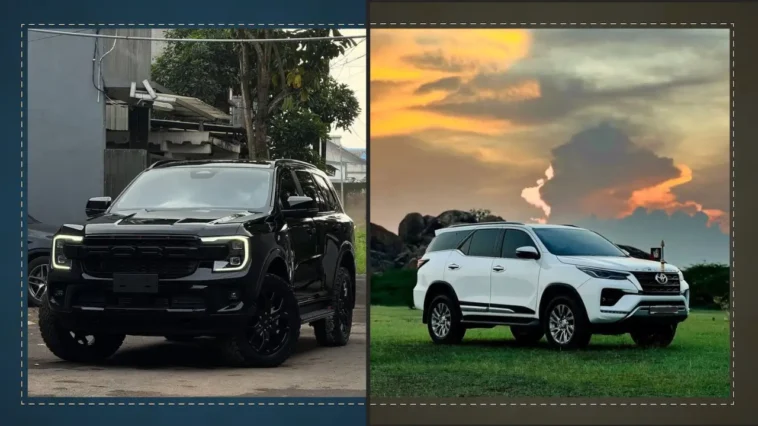
The body-on-frame SUV segment has always been a two-horse race in South and Southeast Asia, and 2026 is no different. Toyota Fortuner 2026 vs Ford Endeavour is the comparison every serious SUV buyer wants to read before writing a cheque because both vehicles target the same buyer, promise the same off-road confidence, and arrive with diesel engines that pull serious weight.
Engine Numbers
The 2026 Toyota Fortuner runs a 2.8-litre 4-cylinder turbocharged diesel engine producing 204 PS and 500 Nm of torque on automatic variants. The Ford Endeavour, depending on the market variant, offers either a 2.0-litre EcoBlue turbodiesel or the older 3.2-litre 5-cylinder TDCi producing up to 197 bhp and 470 Nm. Sources say Toyota’s addition of a 48V mild hybrid system gives the Fortuner a meaningful torque delivery advantage at low city RPMs.
Toyota Fortuner 2026 vs Ford Endeavour: Spec Sheet
| Specification | Toyota Fortuner 2026 | Ford Endeavour |
|---|---|---|
| Engine | 2.8L diesel (2GD-FTV) | 2.0L EcoBlue / 3.2L TDCi |
| Power | 204 PS at 3,400 rpm | 170 PS / 197 bhp at 3,000 rpm |
| Torque | 500 Nm (AT), 420 Nm (MT) | 420 Nm / 470 Nm |
| Hybrid System | 48V mild hybrid (ISG) | None |
| Transmission | 6-speed MT / 6-speed AT | 6-speed AT / 6-speed MT |
| Drive Options | 2WD and 4WD | 2WD and 4WD |
| Wheelbase | 2,745 mm | 2,850 mm |
| Ground Clearance | 221 to 225 mm | 225 mm |
| Fuel Tank | 80 litres | 80 litres |
| Boot Space | 296 litres | Not publicly disclosed |
| Kerb Weight | ~2,180 kg | ~2,204 kg |
| Seating | 7 | 7 |
Towing Capacity
The 2026 Toyota Fortuner carries a braked towing capacity of up to 3,100 kg on standard variants. Reports suggest the updated model — particularly the 4WD AT variant with the 48V hybrid system — may push this figure to approximately 3,500 kg when officially certified. The Ford Endeavour’s 3.2-litre TDCi variant also tows up to 3,100 kg, while the 2.0-litre variant is rated lower at around 2,500 kg.
Off-Road Technology
- Fortuner 2026: Crawl Control (5 speed settings), Multi-Terrain Select, Active Traction Control, Downhill Assist Control, part-time 4WD with rear diff lock, 700 mm wading depth
- Ford Endeavour: Terrain Management System (6 modes including Sand, Grass/Gravel/Snow, Mud/Ruts, Boulders), Electronic Locking Rear Differential, 800 mm wading depth
- Both use a body-on-frame ladder chassis for maximum off-road durability
- Insiders suggest the Endeavour’s Terrain Management System covers more terrain modes than Toyota’s Multi-Terrain Select at equivalent trim levels
Wading and Ground Clearance
Know who wins the water-crossing contest: the Ford Endeavour edges ahead with a rated wading depth of 800 mm compared to the Fortuner’s 700 mm. Both SUVs sit at 225 mm of ground clearance, making neither vehicle definitively superior on that single metric. Sources say the Endeavour’s longer wheelbase of 2,850 mm also provides better straight-line stability on rough trails.
Suspension Setup
The Fortuner 2026 uses a double-wishbone front suspension and a four-link coil spring rear setup, tuned for a blend of road comfort and off-road articulation. The Endeavour runs a twin I-beam independent front suspension and a Watt’s linkage rear coil setup on select variants. Reports suggest the Endeavour’s longer wheelbase and Watt’s linkage deliver more planted on-road composure, while the Fortuner’s shorter wheelbase gives it tighter off-road handling.
Dimensions Compared
The Ford Endeavour is noticeably longer and has a longer wheelbase than the Fortuner:
- Fortuner length: 4,795 mm vs Endeavour length: 4,892 mm
- Fortuner wheelbase: 2,745 mm vs Endeavour wheelbase: 2,850 mm
- Fortuner width: 1,855 mm vs Endeavour width: 1,860 mm
- Both vehicles stand at nearly identical heights of around 1,835 to 1,837 mm
- The extra 105 mm of Endeavour length translates to slightly better third-row knee room
Safety Features
The 2026 Fortuner tops out with Toyota Safety Sense, including pre-collision warning with pedestrian detection, lane departure alert, and 7 airbags on higher trims. The Endeavour offers Ford’s Co-Pilot360 package on international variants, which includes automatic emergency braking, blind spot information system, and rear cross-traffic alert. Not publicly disclosed is whether the Endeavour will receive updated ADAS features in markets where Ford relaunches the nameplate after its India exit.
Cabin and Technology
- Fortuner 2026: 9-inch or larger touchscreen with Android Auto and Apple CarPlay, wireless charging, digital instrument cluster on top variants
- Endeavour: 8-inch SYNC 3 touchscreen (older gen), Bang and Olufsen audio on international variants, 360-degree camera on top trims
- Fortuner offers a fully redesigned interior for 2026 with premium soft-touch materials
- Insiders suggest Fortuner’s cabin refresh brings it noticeably closer to segment-premium territory
Fuel Efficiency
The 2026 Fortuner diesel with 48V mild hybrid returns an ARAI-claimed 14.2 to 14.6 km per litre depending on the variant. The Endeavour’s 2.0-litre EcoBlue claims approximately 12.6 to 14.2 km per litre under standard test conditions. Sources say the Fortuner’s hybrid assist makes the biggest real-world difference in city driving, where stop-and-go traffic typically hurts diesel efficiency the most.
Price and Value
The 2026 Toyota Fortuner is priced from approximately INR 33 lakh to INR 58 lakh across variants in India. The Ford Endeavour’s expected price sits around INR 50 lakh on return, though Ford has not officially confirmed an India relaunch date as of February 2026. Insiders suggest the Fortuner’s stronger resale value, wider service network, and new hybrid powertrain give it a stronger long-term ownership case in the Indian market.
Also Read: 7 Indian Celebrities You Didn’t Know Owned a Volkswagen
Both SUVs are impressive machines but only one of them has a 48V hybrid, a freshened interior, and a service centre near your home.
Which would you pick: the trusted Fortuner with its hybrid edge, or the Endeavour with its terrain tech and extra wading depth? Let us know in the comments below.